

WHITE PASSAGE™ FOR IDENTITY CRISIS
When You No Longer Know Who You Are
A business loss, divorce, retirement, empty nest, major life change, or loss of status can leave you unsure who you are without the role that once helped define you.
You may know what ended. You may not know who you are without it.

“My company is gone. If I’m not the founder anymore, who am I?”
—The Founder
THE SHATTERING
When a Role Ends, Your Sense of Self Can Go With It
Founder. Spouse. Parent. Provider. Leader. Caregiver. Professional. Athlete. Successful one. Needed one.
Roles can become so connected to identity that losing one feels like losing part of yourself.
You may find yourself asking:
- Who am I without this role?
- Was that what made me valuable?
- What parts of me are still here?
- Do I rebuild the old identity or let it go?
- What do I actually want now that this chapter has ended?
- How do I move forward when the person I knew how to be no longer fits?
The role may be gone. The deeper problem begins when you no longer know how to understand yourself without it.
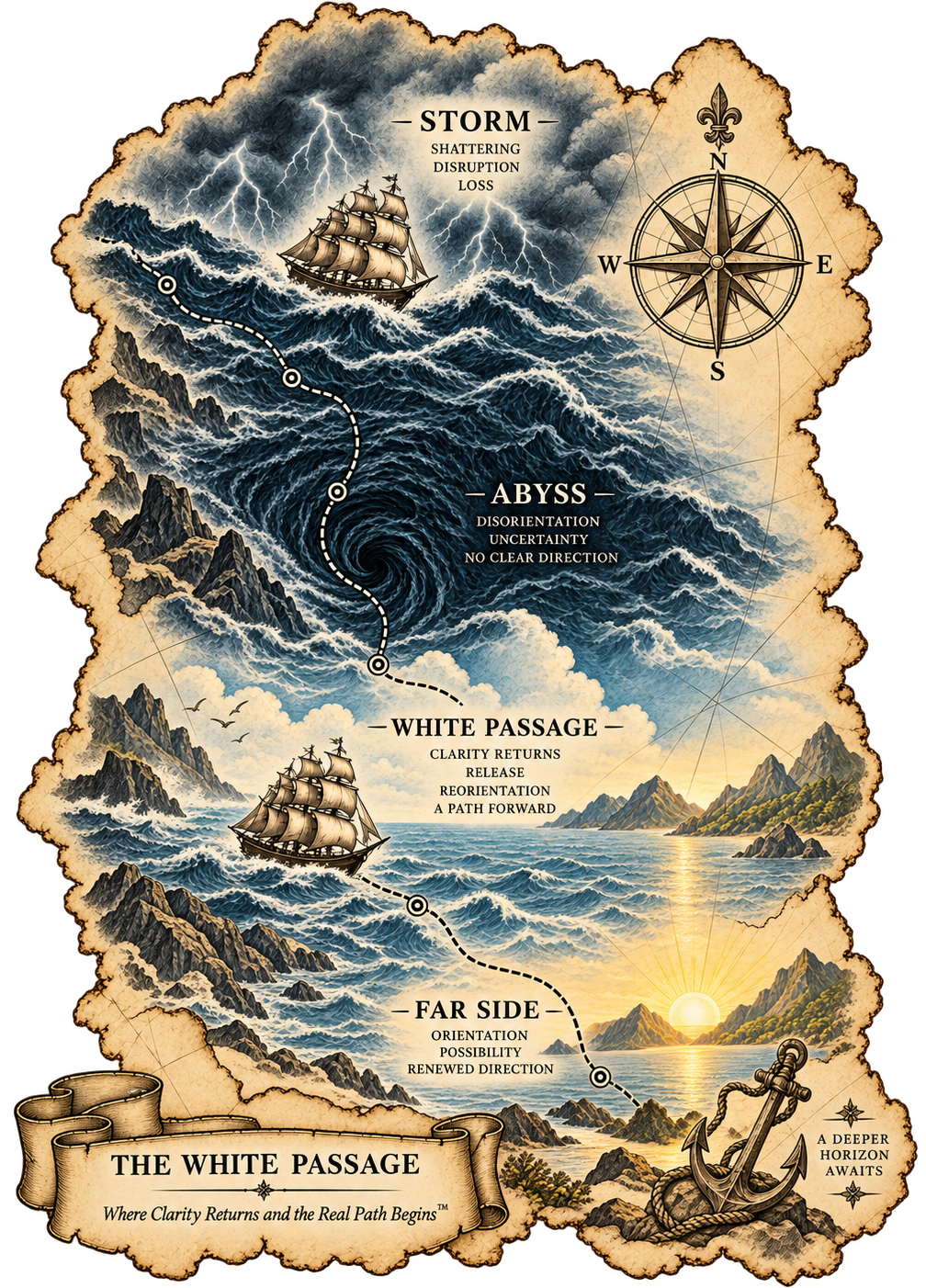
↓ When the your identify crisis changes your life this deeply, you’ve entered the Abyss.
THE ABYSS
“The waters closed in over me to take my life; the deep surrounded me…” — Jonah 2:5
When You Lose the Role and Your Sense of Direction With It
When You Lose the Role and Your Sense of Direction With It
A company closes. A marriage ends. Children leave home. Retirement arrives. A career disappears. Your health changes. A position, title, community, or status you relied on is suddenly gone.
At first, the problem may seem obvious:
I lost my business.
I'm not married anymore.
I'm retired.
My children don't need me the way they used to.
But underneath that loss, another question can emerge:
Who am I now?
You may feel pressure to quickly find a new role, rebuild what you lost, prove that you're still successful, or become a completely different person before you understand what actually matters to you.
The Abyss begins when you haven't only lost a role—you have also lost the identity and direction that came with it.
↓ White Passage is the way through.
THE WHITE PASSAGE
Find Your Bearings Before You Reinvent Yourself
White Passage helps you understand what ended, separate your identity from the role you lost, and figure out what you want to carry into the next part of your life.
The goal is not to invent a brand-new version of yourself overnight.
First, we figure out what was truly you—and what belonged to the role.
Depending on your situation, we may work through:
What Changed?
Shattering Reconstruction
Understand the event, loss, transition, or series of changes that made your old sense of self stop fitting.
Before & After
Look at how you described yourself before—and how you see yourself now.
What Was Tied to the Old You
Identify the roles, relationships, achievements, beliefs, routines, and expectations that helped hold your identity together.
What Are You Believing About Yourself Now?
Fact vs. Conclusion
Separate what actually changed from conclusions such as I failed, I’m not enough, I’ve wasted my life, or I don’t know who I am anymore.
Role vs. Person
Separate being a founder, spouse, professional, provider, caregiver, athlete, believer, or another role from everything else that is still true about you.
Borrowed vs. Chosen Identity
Look at which parts of your identity came from family, culture, work, relationships, achievement, or other people—and which parts you still choose for yourself.
What Is Still True About You?
Strengths & Capabilities
Identify qualities, abilities, experience, interests, and ways of contributing that survived the change.
What Still Matters
Clarify the relationships, values, needs, interests, and parts of life that still feel important.
What You Do Not Need to Become Again
Decide which parts of your old identity are worth carrying forward and which no longer need to define you.
Who Can You Become From Here?
Possible Futures
Explore different ways your life could develop without demanding that you immediately choose a new permanent identity.
Reality Testing
Try new roles, directions, relationships, or ways of living and see what actually fits.
The goal is not to invent a new version of yourself as quickly as possible. It is to understand what remains true enough to build from.
The goal is not to replace one identity with another. It is to understand yourself well enough that your next direction is chosen by you—not simply by the role you lost.
↓ The Far Side is where clarity returns.
THE FAR SIDE
The Far Side Is Knowing Who You Are Without the Old Role
The Far Side does not mean you have created the perfect new identity.
It does not mean you never miss the person you were, the status you had, or the life that came with it.
It means the old role no longer has to answer the entire question of who you are.
You understand what ended.
You know what parts of yourself remain.
You have a clearer sense of what matters now and what you want the next chapter of your life to include.
Maybe you build something again.
Maybe you choose a quieter life.
Maybe you take on a completely different role.
Maybe parts of the old identity come with you in a new form.
You no longer need the old title to know which direction feels like your own.
↓ You don’t need all the answers to begin.
“The goal is not to sail as though storms no longer exist. The goal is to raise your sails again knowing that they do.”
—Thomas Minieri
Questions We Take Seriously
Identity advice is full of phrases that get repeated so often they can start to sound like fact.
- You just need to find yourself.
- Your job, marriage, or role was never your identity.
- Just reinvent yourself.
- Be your authentic self.
- You need to get your confidence back.
Sometimes those ideas are helpful. Sometimes they skip over the harder question. White Passage is willing to look closer.
What Does “Find Yourself” Actually Mean?
It sounds simple.
But after a major life change, you may genuinely not know which parts of the old you still fit.
You may have spent years as a spouse, parent, founder, leader, professional, caregiver, athlete, provider, believer, or some other role that helped organize your life.
When that role changes or disappears, “just find yourself” may not tell you very much.
The better questions may be:
What changed?
What still feels true?
What did that role give you?
What parts of you existed before it—and what parts grew because of it?
You do not need to discover a hidden “real you.” You need to understand what is still true now.
Was My Old Identity a Mistake?
Not necessarily.
A role can matter deeply without being the whole of who you are.
Your career may have expressed your ambition.
Your marriage may have expressed love, commitment, family, and belonging.
Your business may have expressed creativity and leadership.
Your faith may have shaped how you understood meaning and purpose.
The problem is not that those things mattered.
The problem begins when losing one of them makes it feel as though nothing else about you remains.
White Passage helps separate the role you lost from the person who is still here.
Should I Just Reinvent Myself?
Maybe eventually.
But reinvention can become another way to rush past the uncertainty.
A new job, relationship, business, lifestyle, belief system, or image of yourself can feel exciting because it gives you something new to hold onto.
That does not automatically mean it fits.
Before building a new identity, it helps to understand:
What am I actually trying to replace?
Otherwise, you may simply trade one fragile identity for another.
What If I Don’t Like Who I Am Now?
A major shattering can change the way you see yourself.
You may start thinking:
I failed.
I was foolish.
I’m weak.
I’m not who I thought I was.
I have nothing special left.
Those feelings matter.
But they are not automatically facts.
White Passage helps you examine what actually changed and which conclusions you formed because of what happened.
Something happening to your identity is not the same thing as everything you now believe about yourself being true.
How Do I Know Whether I’m Actually Becoming Someone New?
Identity does not usually change in one dramatic moment.
You try things.
Some fit.
Some do not.
You may feel confident one week and uncertain the next.
A setback can make you feel like you have lost yourself all over again.
A good week can make you think everything is finally solved.
Neither feeling tells the whole story.
The question is whether the life you are building continues to fit what is actually true about you.
How Is White Passage Different From Therapy?
Therapy can be valuable for emotional health, self-esteem, relationships, mental health, and many other needs.
White Passage is designed around a different question:
How do I regain my bearings when the person I thought I was no longer fits the life I am living?
That means we may work through what changed, the roles you lost, what you used to believe about yourself, what you believe now, what remains true, what still matters, and which possible futures are actually supported by your life as it exists today.
White Passage is not open-ended processing.
There is a passage we are working through together.
You remain the one who decides where it leads.
YOUR JOURNEY BEGINS
You Don’t Have to Know Who You’re Becoming Yet
You may feel pressure to reinvent yourself, choose a new direction, become more confident, or figure out who you are now.
But when an important part of your identity has been shattered, forcing a new answer too quickly can create another identity you eventually have to escape.
You do not need the final answer to begin.
White Passage starts with where you are now—what changed, what you used to believe about yourself, what you believe now, what still feels true, and what you need to understand before deciding who or what comes next.
Ready to See If White Passage Is Right for You?
Book a private White Passage Orientation. We’ll talk about what brought you here, where you feel most lost, and whether the 90-day passage makes sense for where you are now.

Book Private White Passage Orientation with Thomas Minieri
Author of White Passage and creator of the White Passage method
90 Days. 9 Stages. One Guided Passage From Lost to Oriented Again.
White Passage™ is a structured 90-day journey for people whose lives have been disrupted deeply enough that they no longer know what to believe, what matters now, or what to do next.
You begin with the White Passage Survey to establish where you are.
Then, over nine stages, you work privately with White Passage author Thomas Minieri while moving through the Captain’s Log—33 guided entries that help you understand what shattered, why you ended up in the Abyss, regain your bearings, test a path forward, and reach the Far Side.
This is not an open-ended series of conversations. There is a passage we are working through together.
Your White Passage Includes
White Passage Survey
Your starting assessment. Before your first Navigation Session, you complete a structured survey to identify what shattered, where you feel most lost, the decisions in front of you, and where your passage needs to begin.
9 Private Navigation Sessions
Work one-on-one with White Passage author Thomas Minieri throughout the 90-day journey. Each session has a purpose within your passage—not simply whatever happens to be on your mind that week.
The Captain’s Log
Your personal guide through White Passage: 33 guided Log Entries plus the final Landfall Letter, taking you from Shattering through the Abyss, Reorientation, the White Passage, and the Far Side. You aren't simply reading it. You're creating a record of your own passage as you go.
Navigator's Instruments
Your passage includes tools chosen for your situation. For identity crisis, these may include:
- identity crisis reconstruction
- before-and-after identity mapping
- role and identity separation
- beliefs and assumptions review
- strengths and capability inventory
- future identity and life options
- reality testing
Between-Session Guidance
Support while you're actually crossing—not only while you're sitting in a Navigation Session.
Landfall Plan
At the end of your 90 days, we bring the passage together: what you now understand, what may remain uncertain, what matters, what direction you have chosen, and what you need to watch as you move forward.
You leave with a clearer map—not just memories of the conversations that got you there.
Start Your White Passage™
You don't need to know where the journey ends. You only need to know you're ready to find your way.
Your first step is a private White Passage Orientation. We’ll start with what happened, where you feel most lost, and what you’re trying to understand or decide.
Book Private White Passage Orientation with Thomas Minieri
Author of White Passage and creator of the White Passage method
Shattered
Read the Blog Journal
Articles on betrayal, loss, identity, faith, career collapse, and what happens when life stops making sense.
About Thomas
Meet the Author
The story behind White Passage, what shaped it, and why Thomas created a framework for finding direction after life falls apart.
Common Questions
Understand the Passage
Answers about what White Passage is, how the 90-day process works, what it is not, and whether it fits where you are now.